The Art of the Interim: Finding Sustenance in the Long Layover
A layover isn't a hurdle to clear, but a rare pocket of time to taste the world between destinations.
The Architecture of the Departure Lounge
There is a peculiar, liminal beauty to the long layover. You exist in a state of suspended animation, untethered from your origin and not yet claimed by your final destination. For the weary traveler, the impulse is often to settle for the nearest plastic-wrapped sandwich, but I invite you to see these hours as an invitation. A layover is not a penalty; it is a small, unexpected travel experience carved out of the commute.
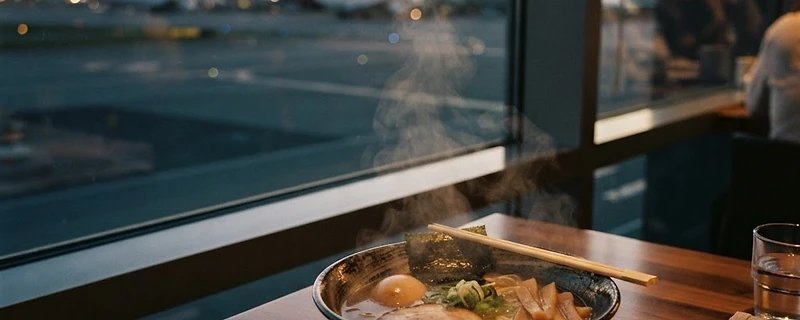
True airport dining requires strategy. It demands we move beyond the terminal concourse and seek out the quiet corners where local pride persists. If you find yourself in Tokyo’s Haneda, skip the westernized chains and head straight for the dedicated ramen street, where the steam of tonkotsu broth cuts through the recycled air. In Singapore’s Changi, you are already in one of the world’s great food halls; a plate of Hainanese chicken rice at a mid-level kiosk can rival the city's finest restaurants.
Seeking the Authentic Beyond the Gates
When the layover stretches beyond five hours, the city itself becomes accessible. The goal is to maximize flavor while minimizing the anxiety of the return through security. I have learned to map my excursions around three essential pillars: distance from the rail line, the presence of a local queue, and the simplicity of the menu.
Consider these tactics for navigating a short, savory detour:
- The 30-Minute Radius: Map out one neighborhood directly connected to your transit hub by a high-speed express train; do not attempt a destination that requires a car.
- Prioritize the 'Quick-Sit': Look for establishments with high turnover—noodle shops, dim sum parlors, or bakeries—where the food arrives within minutes of ordering.
- The Departure Clock: Always set a hard 'go-back' alarm on your phone, factoring in an extra 45 minutes for unexpected security queues.
In cities like Copenhagen, a quick trip into Vesterbro for a smørrebrød—open-faced rye bread layered with pickled herring or roast beef—is an exercise in Danish efficiency. It is light, deeply flavorful, and requires no heavy digestion, leaving you ready for the pressurized environment of the cabin.
The Ritual of the Return
As you return to the terminal, the rush of the city fades into a quiet, post-prandial hum. There is something profoundly civilized about sitting down in a foreign gate area with the lingering taste of a local specialty on your palate. You have done more than just wait; you have participated in the culture of a place that was never on your original itinerary.
Eating well while traveling is an act of reclaiming your time. By choosing a bowl of spicy mapo tofu in a Chengdu transit hotel or a crusty baguette in a quiet corner of Paris Charles de Gaulle, you tether your journey to the earth. You are no longer just a passenger in transit; you are a diner in the world, finding nourishment in the spaces between the lines.
This article may contain affiliate links. Trippanna earns a commission on bookings made through partner links, at no extra cost to you. All bookings are the responsibility of the third-party provider.